

From wildfires in California to floods in Pakistan, there is no denying climate change’s effects on our world. The IPCC’s most recent report on climate change states that disasters resulting from our shifting climate are already worse than predicted. But it isn’t just natural disasters that pose a danger; man-made hazards like oil spills and nuclear emergencies are an ever-present risk, too. We have to be ready.
But how do you stay ready for events that can’t always be predicted? It comes down to preparation and response, and technology is essential. Tools like ArcGIS and Twinview are already being used to monitor at-risk areas, analyze vast datasets to try and predict emergencies, and prepare a response. These tools, however, all rely on 2D screens. This means teams are using maps and visualizations that can’t convey the true detail of the environment. Not only does the information take more time to decipher, but it’s not 100% accurate either.
This is where holograms can help. Using light to create a natural 3D image that appears within a holographic display, this new technology can be used to rapidly and accurately assess a virtual recreation of the environment. Integration with AI-powered platforms can even help predict dangers, identify preventive measures, and analyze real-time data.
In this blog, we’ll look at how these technologies improve our ability to plan for and respond to emergencies and what this means for the future. But first, let’s lay down the basics of disaster planning and response.
Disaster planning involves ongoing efforts to predict potential emergencies, mitigate the dangers and damage, and plan the most effective response should they happen. It takes experts in the environment, engineering, social sciences, and much more to make this work. After all, disasters have wide-ranging effects, from threatening people’s lives and livelihood to endangering local wildlife and damaging infrastructure. These effects can be felt for decades after the event.
In the event of a disaster, there will be a coordinated response involving the government, emergency services, organizations, and charities. Circumstances are ever-evolving, and it’s virtually impossible to be fully prepared for any disaster, but the more thorough the planning, the more effective the response. Resources will be allocated where needed, people will be evacuated from affected areas, and teams will work to limit the damage.
Technology is key to disaster planning and response. Some examples of this include:
All of this technology — and more besides — is intended to give experts and responders the clearest possible picture of events on the ground, with which they can make critical decisions before or during an emergency. However, it has one major limitation: the 2D screen.
Our brains make sense of the world in 3D, using cues like depth, parallax, and focus to determine physical properties. Although we’ve gotten pretty good at absorbing information on 2D displays, they’re actually limiting our ability to understand visual information. We might not even realize what we’re missing. When it comes to emergencies and potential disasters, that’s a serious pitfall.
Holograms — like those produced by our first-of-its-kind NOVAC display — replicate how we see objects in real life to create a truly 3D image. Entire teams of experts can study the hologram from almost any angle, and it will retain the depth and detail of the real environment. Because light bounces from the hologram to our eyes naturally, there’s no need for glasses or headsets and no adverse side effects like nausea and eye-strain.
In emergency and disaster planning, holograms are used to:

With their super-accurate visuals, holograms are as close as we’ll get to a window into the real environment. When integrated with AI-powered platforms, they become an intelligent solution for emergency planning and response.
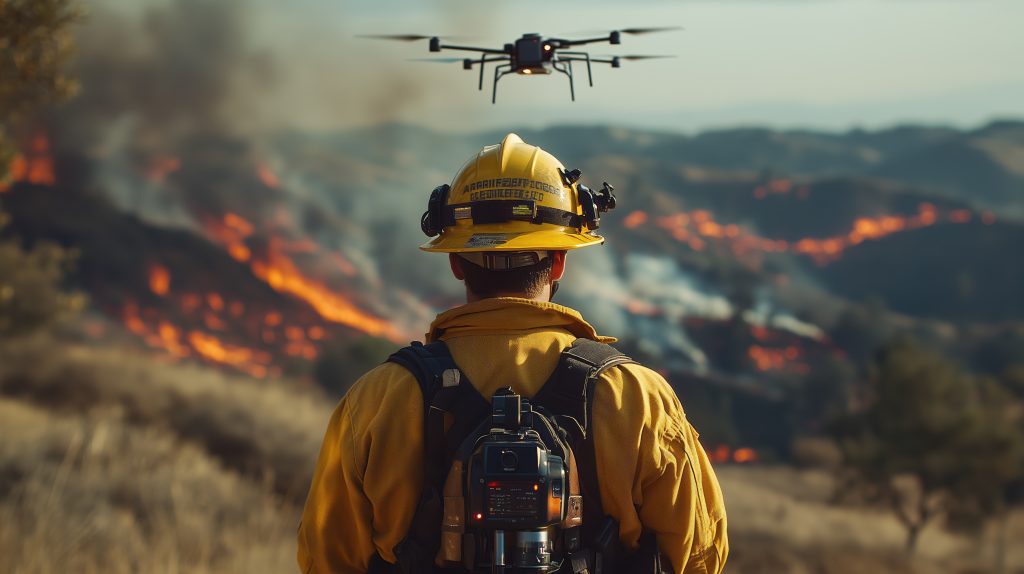
Recently, NVIDIA and Lockheed Martin partnered to create an advanced fire response system to improve the prediction and suppression of wildfires in prone areas. The project combined a digital twin built in NVIDIA Omniverse with an AI model trained by real-world fire data. Real-time physics technology enables experts to simulate variables like wind, humidity, and terrain to ensure complete accuracy.
The system means that experts can interactively study wildfires in real time, supporting better preparedness and response to fires around the world. It’s not a stretch to imagine similar systems being deployed for hurricanes, earthquakes, and any number of disasters.
AI can also rapidly analyze data from sensors, satellites, and other sources, feeding it into software that renders scenes for visualization on a holographic display—enabling faster and more informed decision-making when every second counts. Communication between dispersed teams responding to a disaster is a constant challenge. AI can help to connect these teams through 5G so that they can share vital information.
In a world where environmental emergencies and disasters are more of a risk than ever, the right technologies have arrived to ensure we’re as ready as we can be.
Want to understand the science behind holograms and our NOVAC? Find out more.
