

What if the next big leap in digital transformation isn’t just smarter AI or faster networks—but the ability to see and interact with data in three dimensions?
Holograms, once reserved for science fiction, are beginning to reshape the way we work, learn, and collaborate. Thanks to breakthroughs in light field displays, spatial computing, and AI, they’re finding real-world applications in everything from manufacturing and medical imaging to education and entertainment.
So, how far have we come, and how close are we to the sci-fi visions we’ve long imagined? Let’s explore.
What Holograms Can Do Right Now
Before we start, let’s define holograms real quick.
At their core, holograms are three-dimensional images or videos created using the physics of light. Unlike stereoscopic or simulated 3D effects that trick the brain into perceiving depth, a true hologram recreates the way light actually bounces off an object. This allows viewers to see lifelike 3D content from multiple angles, with depth and realism that changes naturally as they move around it. No illusions, no optical tricks, just a genuine light field reconstruction.
And while we’re still a ways off from seamless, sci-fi-style communication, holographic technology has already taken root in some powerful and practical ways. From factory floors to operating rooms, holograms have the potential to become integral tools in high-stakes, high-precision environments — transforming how professionals visualize and interact with complex information.
However, not all displays are alike. Most holographic or 3D visualization tools on the market today fall into three primary categories: VR headsets, AR glasses, and light field or volumetric displays. Each offers its own benefits, but also introduces limitations.
Virtual reality headsets offer full immersion, but at the cost of isolation. Users are cut off from their physical surroundings and each other, making collaboration difficult. While VR is powerful for individual training or simulation, the solitary nature of VR makes it less ideal for group-based problem-solving and decision-making in real time.
Augmented reality glasses attempt to bridge physical and digital worlds, overlaying 3D content on the real world. However, AR still relies on specialized headgear, suffers from limited field of view, and struggles to present richly detailed, high-resolution images—especially when depth is critical to the experience. There’s also the adoption barrier; not everyone wants to wear a headset or glasses all day.
Pepper’s Ghost-style displays, often seen in concerts or trade shows, can create a dramatic effect but don’t offer true 3D depth. The illusion breaks as soon as the viewer changes perspective, and the tech isn’t practical for real-world data interaction or spatial visualization.
This is where NOVAC truly stands out from the crowd. Our holographic display creates glasses-free 3D holograms, allowing multiple people to simultaneously see the same content from different angles. It delivers ultra-high resolution and smooth animation playback at up to 30 frames per second, which means no flicker, no motion blur, and no nausea-inducing artifacts.
In short: VR isolates, AR overlays but struggles with fidelity and field of view, and other displays offer spectacle but lack interactivity. NOVAC enables true collaboration and effortless viewing, without requiring users to wear bulky headgear or compromise quality.
This difference in usability becomes especially powerful when applied to complex, real-world workflows like those found in manufacturing. Companies like BMW and GE already use digital twins—real-time 3D replicas of physical systems—to optimize operations and test changes virtually before making physical adjustments. BMW, for instance, uses NVIDIA Omniverse to model entire factories in 3D, creating detailed simulations that can be explored and refined from a standard web browser.
By integrating a holographic display like NOVAC into this workflow, teams could move beyond flat screens and truly see the data in three dimensions—standing around the simulation, analyzing changes, and making changes together. Thanks to improved tooling and visualization pipelines from platforms like Unreal Engine and Unity, these holographic experiences are becoming easier to implement across industries.
In healthcare, holograms are proving invaluable for surgical planning, operation, and education. Surgeons can interact with 3D models of patient anatomy with a level of spatial awareness that flat screens simply can’t offer. Medical students benefit from layered, rotating visualizations that bring anatomy to life—far beyond what textbooks or previously dissected cadavers can provide. One study even found holography to be more effective than traditional 2D imaging for teaching anatomy.
Defense is another area where holograms are taking hold. Military teams use holographic terrain models for mission planning and situational awareness, enabling real-time visualization of landscapes, buildings, and potential troop movements. These dynamic maps improve clarity and coordination in high-stakes environments where timing and accuracy are everything.
As holographic technology evolves, its potential to transform industries becomes increasingly clear. Whether it’s enhancing decision-making on the factory floor, improving patient outcomes in the operating room, or strengthening mission planning in defense, holograms are paving the way for more interactive, data-rich experiences. The future lies in the ability to not just see but truly engage with digital content in 3D, creating environments where collaboration, precision, and insight are at the forefront. The real promise of holography isn’t just in the images we see—it’s in how we interact with them to solve complex problems and make better decisions.
What Holograms Can’t Do (Yet)
Despite all the progress, there’s still a big difference between what holograms can do in high-tech labs—or on a concert stage—and what they can deliver in everyday life. Even as display options expand, the technology faces real limitations that keep it just out of reach for most users.
High-fidelity holograms require serious hardware like specialized projectors, light field displays, and AR headsets. That kind of tech doesn’t come cheap, and scaling it for everyday use remains a major hurdle. Until production costs come down, widespread adoption will likely stay limited to industries that can justify the investment.
Then there’s the issue of interaction. Holograms can trick the eye, but not the hand. Our NOVAC display currently supports input via mouse, keyboard, and game controllers, and basic voice control. But full gesture recognition—and especially true haptic feedback—is still on the frontier. Some experimental systems use ultrasonic waves or air pressure to simulate touch, but we’re far from replicating the feeling of holding or manipulating a holographic object with any realism.
Visibility is another constraint. Holograms often rely on specific lighting conditions to look their best. Bright environments or uncontrolled lighting can wash out the image, and some systems require viewers to stand in a specific position or use a particular setup to see the hologram properly. These limitations make everyday use, especially in public or mobile settings, difficult.
At a fundamental level, some of the most awe-inspiring sci-fi visions may not be possible at all. Avalon Holographics CEO Wally Haas recalls a quote: “No amount of money buys you new physics.” While something like a Star Trek holodeck might be feasible in tightly controlled environments, the free-floating, photorealistic holograms we see in movies may remain fiction.
Where the Tech Is Headed
While current limitations remind us that holograms aren’t magic, they also point the way forward. Progress is being made—not just in how holograms look, but in how they function as tools for collaboration, analysis, and decision-making. That’s where NOVAC comes in.
At Avalon Holographics, we believe the future of holographic technology isn’t just about visual fidelity. It’s about creating shared experiences that help people understand complex information, solve problems together, and make faster, more confident decisions. Whether it’s immersive training, digital twins, or medical imaging, the NOVAC display redefines what’s possible with light.
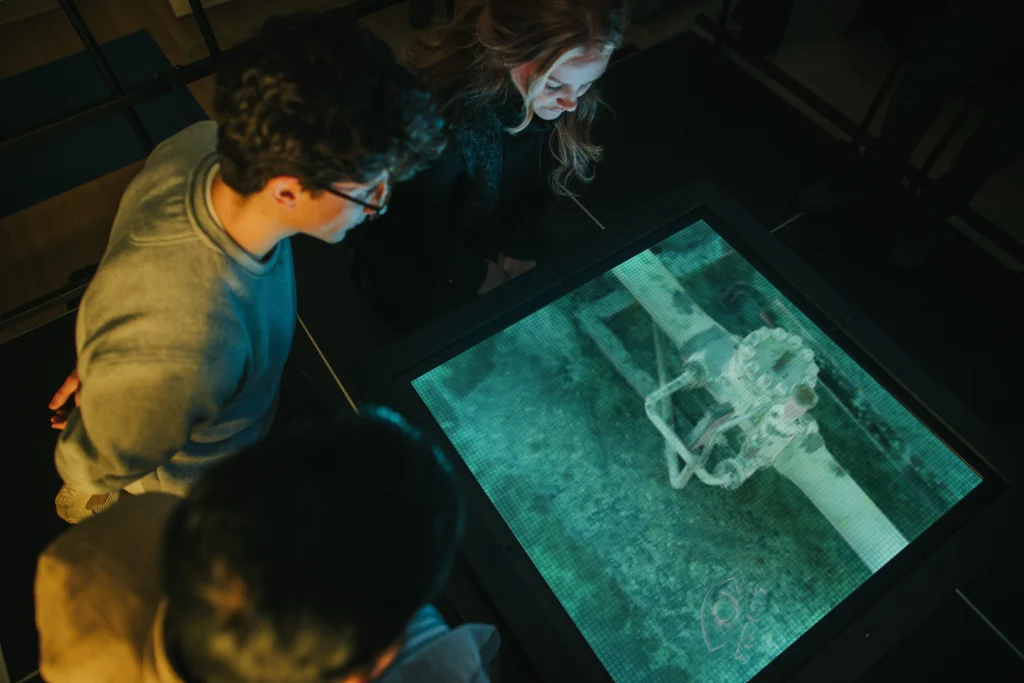
At the heart of NOVAC is a sophisticated optical engine. LED light sources are funneled through a complex system that generates billions of individual light rays. These rays are color-timed using rapid RGB sequencing—red, green, and blue pulses so fast that the human eye perceives a smooth, continuous 3D image. With an ultra-high resolution of 63,888 x 69,696 and more than 4.5 billion active pixels, NOVAC is one of the clearest glasses-free 3D displays in existence. Its wide 74-degree viewing angle allows multiple people to see the image from different perspectives simultaneously, enabling true group collaboration around a single, shared visual.
“After seeing Avalon’s prototype, I was eager to share their vision with the radiology community. Beyond the ability to look ‘around’ the complex anatomical models generated by GE Healthcare’s Advantage Workstation, there was enough space for several people to experience the 3D visualization simultaneously,” said GE Healthcare’s Colin Holmes. “The fact that their hardware and software work with standard geometry files allows the technology to easily pair with GE’s AW 3D Suite, promising ease of access to group holographic experiences as part of the existing medical imaging workflow.”
As Wally Haas puts it, “We’re attempting to create collaborative, trusting environments where impactful teams can get together and make good decisions.” In fields like medicine, defense, and robotics—where the stakes are high and the margin for error is razor-thin—this kind of shared understanding can be a game changer.
Cross-Industry Synergy with Artificial Intelligence
As NOVAC pushes the boundaries of what holograms can do visually and collaboratively, the next frontier lies in pairing holography with artificial intelligence. If holographic displays help us see complexity, AI helps us understand it—and together, they can transform how we interpret and act on vast amounts of information.
Imagine an AI system analyzing millions of underused data points in a hospital, identifying patterns that would take humans days or weeks to find. Now imagine those insights projected as a 3D model on a NOVAC display, where specialists—radiologists, oncologists, and surgeons—can gather in the same room, interact with the data, and identify anomalies in real time. That kind of immersive, collaborative decision-making isn’t hypothetical—it’s a use case Avalon Holographics is actively working toward.
The synergy between AI and holography extends far beyond healthcare. In manufacturing, for example, a robotics team might use AI to detect anomalies across hundreds of sensors on a production line. The NOVAC display could render that anomaly spatially, allowing engineers to instantly pinpoint the issue and troubleshoot more precisely. “AI is very good at looking for patterns. The NOVAC display would make those patterns visible and understandable to the people who need to act on them,” said Haas.
As production costs decline and accessibility improves, the potential for cross-industry impact will grow. We envision future iterations of our technology making their way into public safety, city planning, immersive entertainment, and beyond. AI and machine learning are already embedded in our everyday lives—integrating them into holographic systems is not just a natural progression; it’s a powerful multiplier that will help unlock the full potential of this technology.
The Future Is in Focus
As holographic technology continues to evolve, it’s doing more than bringing 3D images to life—it’s reshaping how we interact with the world’s most complex information. When layered with AI and spatial computing, holograms become powerful tools for insight, enabling teams to see patterns, spot anomalies, and understand systems in a more intuitive, collaborative way.
At the heart of every holographic breakthrough is a simple idea: when people can see more clearly, they can act more confidently. Whether it’s diagnosing a patient, optimizing a factory, or planning a mission, the value of holography lies in making information not just visible, but meaningful. That clarity—and the human decisions it supports—is what will define the next era of innovation.
