

Princess Leia’s plea for help, Iron Man’s fabrication lab, you know what nobody tells you about those cool holograms we see in movies? You’d need to ionize air into plasma to make them work. This laser fest would not only be inefficient and highly dangerous to anyone in its general proximity, the results wouldn’t even look that good.
Still, who doesn’t want to see that technology in action? Several generations of moviegoers certainly do, after years spent marveling at the hologram’s visual superiority over the common flat screen. But what most of those fans don’t know is that holographic displays are further along than they think. They’re actually not only here, but incredibly useful. They just work a little differently than they do in the movies.
So, how do these holographic displays work? And what can you do with them? We’ll dig into all of that in this blog, but first, let’s establish what exactly we mean by hologram.
A hologram — from the Greek words holos, meaning “whole,” and gramma, which means “message” — is a high-quality 3D image that behaves naturally when viewed from different angles. That means your eyes should be able to focus normally on the hologram without any adverse effects like migraines or dizziness. When you move around it or look from above or below, the hologram should behave as though it’s really there, despite being made entirely of light.
The possibility of creating a hologram was stumbled upon when a Hungarian scientist called Dennis Gabor was attempting to improve the quality of electron microscope imagery. But the way he envisioned it is not the only way.
Starting from first principles, a holographic display creates light to render a hologram. You could also call it a light field display. It presents the viewer with a truly 3D, natural image that you can see without the use of cumbersome headsets or expensive glasses. However, a light field display only qualifies as a holographic display if it produces images of a high enough quality. Remember, realism is a defining characteristic of holograms.
To work, a holographic display needs to control the direction of light and a huge number of tiny pixels, far smaller than a normal display could support. Pixels usually control the color and intensity of an image but not the direction of light. That’s why the images we see on a 2D display are always flat.
Controlling the color, intensity, and direction of light from a single point creates a hogel. A hogel is a cluster of minuscule pixels that presents a different color and intensity from a single point on the display, depending on which angle you’re looking at it from.
A hologram, then, is the result of light being directed by lots and lots of hogels. The number of hogels you have on a holographic display determines the quality of the image. Without enough of them, the hologram’s spatial resolution will be too low, and it’ll appear blurry or distorted.
We see the world around us because light bounces off objects and into our eyes. A holographic display is, in essence, a high-tech way to mimic that process. It creates a virtual object that our brain recognizes as real. That’s how it achieves a depth that can’t be replicated by other 3D technologies like virtual reality.
With enough hogels, the depth and field-of-view of your hologram depends on maximizing the number of light rays per hogel. The bigger the area you’ll be viewing your hologram in, the more light rays you’ll need. The more tightly packed those light rays are, the more depth you can show. Viewing requirements depend largely on what you’re using your hologram for, but enabling the biggest field of vision and most depth possible is generally best.
Let’s say, for example, that you want to see your hologram from a 90-degree angle horizontally and vertically. If you wanted one ray per degree, that would require 8,100 pixels in each hogel, which would create a few inches of depth. In the likely event that you want even more depth, you’ll need tens or even hundreds of thousands of pixels per hogel.
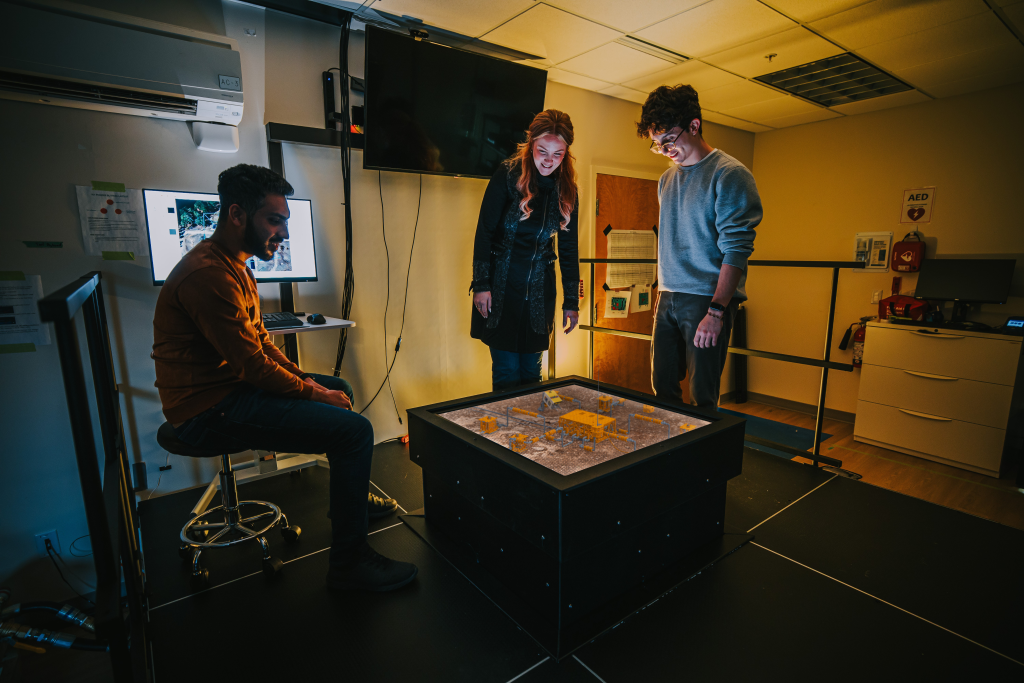
So, how do you keep control of all these hogels? A holographic display requires the computing power of thousands of 2D displays. It’s more than a standard GPU can handle. That’s why holograms have been confined to science fiction until now. At Avalon, we’ve solved this issue with powerful hardware and custom software. The result is NOVAC, a holographic table display that powers realistic 3D images.
Most of us are so captivated by the undeniable coolness of holograms that we haven’t thought all that much about what purpose they serve. Industries now have access to images that convey the accurate depth and characteristics of an object or environment. They can use an interface to manipulate the image, gather around it in groups, and make critical decisions based on the accuracy of the visual information. The possibilities are vast.
Some of the current uses for holographic displays include:
Of course, these are just a few of the ways holographic displays can be used. Industries like automotive, manufacturing, and space exploration can find value in them, as well. Basically, if your role or decision-making team would benefit from realistic 3D images being fed with up-to-date data, then holographic displays are going to be useful. Holograms might not be exactly what we see in the movies, but we were right to be excited about them. It’s a transformative technology, and we’ve only seen the beginning.
Curious about Avalon Holographics and our NOVAC display? Find out more.
